
Foot & ankle
Keyhole Foot and Ankle Surgery: Why It’s Not Just for Bunions
Learn how keyhole foot and ankle surgery can treat bunions, sports ankle injuries, cartilage damage and other conditions with Dr Sheraz Anjum at Joint Vision.
Back to Insights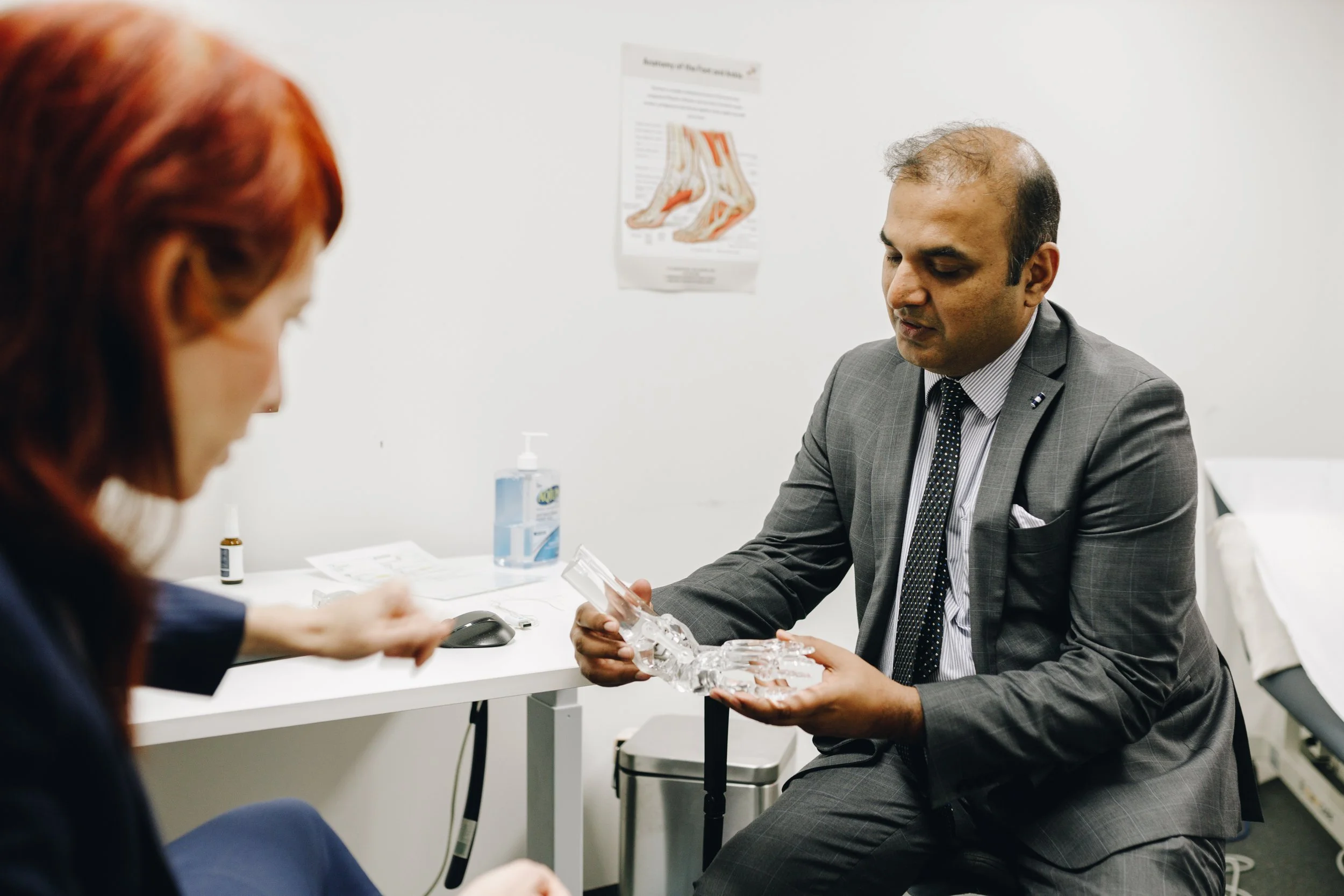
September 3, 2026
Written by
Joint Vision
Dr Sheraz Anjum discusses foot and ankle treatment options with Dr Meghan Dares at Joint Vision Orthopaedic Group.
Dr Sheraz Anjum is an Orthopaedic Surgeon at Joint Vision Orthopaedic Group, specialising in foot and ankle surgery, complex trauma and limb reconstruction. With more than 15 years of local and international experience, he focuses on relieving pain while preserving movement. Dr Anjum is also Head of Department – Orthopaedics at Wollongong and Shellharbour Hospitals.
When people hear the term keyhole surgery, bunion surgery often comes to mind.
But minimally invasive techniques are now used to treat a much wider range of foot and ankle conditions, including sports injuries, cartilage problems, tendon conditions and some forms of arthritis.
“Bunions are only a small part of what we do with keyhole techniques,” Dr Sheraz Anjum said.
“A large proportion of foot and ankle procedures can now be done using minimally invasive approaches.”
What is keyhole foot and ankle surgery?
Keyhole, or minimally invasive, foot and ankle surgery uses small incisions and specialised instruments to access and treat damaged structures.
In some procedures, surgeons use an arthroscope, a very small camera that allows them to see inside a joint.
“The structures in the foot and ankle are quite delicate,” Dr Anjum said.
“There’s not much soft tissue covering the bones and tendons, which means traditional open surgery can sometimes lead to swelling or wound-healing issues.”
Using smaller incisions can reduce disruption to surrounding soft tissue and, in appropriate patients, may help reduce swelling and stiffness, support earlier movement and lower the risk of wound complications.
The exact approach depends on the condition being treated.
Keyhole surgery is used for more than bunions
Bunion surgery is one of the better-known examples of minimally invasive foot surgery, but it is far from the only one.
Keyhole techniques can also be used in the treatment of:
ankle impingement
ligament injuries
cartilage damage
inflammation within the ankle joint
loose fragments within the joint
some tendon problems
selected forms of arthritis
Ankle arthroscopy is one example.
“We use very small cameras, sometimes just a few millimetres wide, to look inside the ankle joint and treat damaged cartilage, inflammation or loose fragments,” Dr Anjum said.
For some patients, this means a condition that once required a larger incision can now be treated through much smaller access points.
Treating sports ankle injuries
Foot and ankle injuries are common in sport, whether they happen suddenly or build over time.
“We see a lot of ankle injuries from sport, both acute injuries and problems that develop over time,” Dr Anjum said.
“Our aim is to get people back to activity safely and efficiently, without compromising long-term joint health.”
Depending on the injury, keyhole surgery may be considered for conditions including ankle impingement, cartilage damage, inflammation within the joint and some ligament injuries.
The aim is to deal with the underlying problem while limiting unnecessary disruption to surrounding tissue.
Rehabilitation then becomes an important part of getting back to activity safely.
Why early movement matters after foot and ankle surgery
Foot and ankle surgery once commonly meant long periods of immobilisation in plaster.
That approach has changed considerably.
“In the past, foot and ankle surgery often meant long periods in plaster,” Dr Anjum said.
“We now know that prolonged immobilisation can lead to stiffness, weakness and delayed recovery.”
Not every patient can put weight through the foot immediately after surgery. But when it is safe to do so, guided movement can form an important part of recovery.
“Even if someone isn’t allowed to walk straight away, they should usually be allowed to move,” Dr Anjum said.
“That prepares the body, and the mind, for the next stage of recovery.”
The timing and amount of movement will depend on the procedure, the injury and the individual patient.
Is keyhole surgery right for everyone?
No.
While minimally invasive surgery has become an important part of modern foot and ankle care, open surgery remains the better option for some conditions.
“It’s not about choosing keyhole surgery at all costs,” Dr Anjum said.
“It’s about choosing the right technique for the problem in front of us.”
More complex deformity correction, reconstruction or certain injuries may still require an open surgical approach.
“At Joint Vision, we match the technique to the condition, not the other way around,” he said.
Surgery is only one part of recovery
At Joint Vision, treatment is planned around the whole recovery process rather than the procedure alone.
Depending on the patient, this may include specialist assessment, imaging, surgical planning, physiotherapy and rehabilitation before and after surgery.
“Successful outcomes don’t come from surgery alone,” Dr Anjum said.
“They come from a clear plan and a team that works together.”
For patients with ongoing foot or ankle pain, recurring sports injuries or difficulty returning to normal activity, a specialist assessment can help establish the cause and determine the most appropriate treatment.
That may include keyhole foot and ankle surgery, another surgical approach or non-surgical management.
Learn more about foot and ankle care at Joint Vision or book an appointment with Dr Sheraz Anjum.
Information on this website is general and may not apply to your circumstances. It does not replace individual clinical advice. If you have a health concern, use the relevant care pathway or speak with a qualified health professional. Seek urgent help for severe or rapidly worsening symptoms or a possible emergency.
What to do next