
Foot & Ankle
Hammertoes and Crossover Toes: Causes, Treatment and Minimally Invasive Surgery in Wollongong
Dr Meghan Dares answers common questions about hammertoes and crossover toes, including non-surgical options, keyhole surgery and recovery in Wollongong.
Back to Insights
November 5, 2026
Written by
Dr Meghan Dares
By Dr Meghan Dares, Orthopaedic Foot and Ankle Surgeon, Joint Vision Orthopaedic Group. Clinically reviewed October 2026.
Bent or overlapping toes are one of the most common reasons people come to see me. They rub on shoes, make exercise harder and can even change the way you walk. Here are the questions I'm asked most often about hammertoes and crossover toes, and how we treat them at Joint Vision in Wollongong.
What is the difference between a hammertoe and a crossover toe?
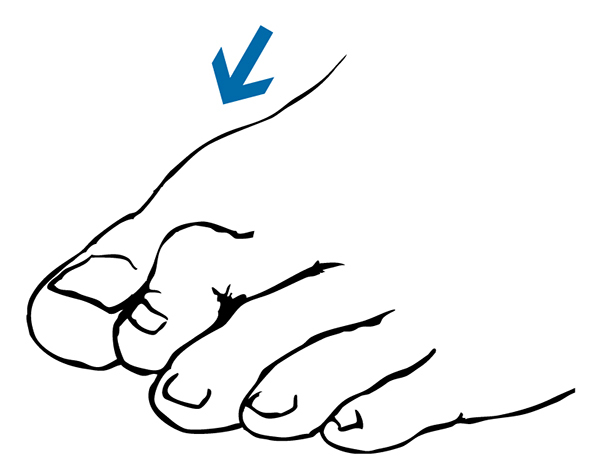
A hammertoe is a bent toe. It most often affects the second toe, but it can occur in any of the smaller toes. It's usually a combination of deformities: the toe bends down at the first knuckle and bends up at its base, where it joins the foot.
A crossover toe is a similar but distinct deformity. The toe still bends at the first knuckle, but it also drifts across so that it sits over its neighbour. Most commonly, the second toe crosses over the big toe. Crossover toes are often associated with a plantar plate tear, an injury to the strong ligament under the base of the toe that normally keeps it stable.
Will a hammertoe straighten on its own?
No. A hammertoe won't straighten without surgery. It doesn't always get worse, but some do progress over time.
What can I try before surgery?
- Wider shoes. Many women's shoes are designed around 2 cm narrower than men's, even though women's feet are only 3 to 4 mm narrower on average. A wider fitting, such as an E fit, or a men's style shoe can take a lot of pressure off the toes. Many footwear stores carry wider fittings or can order them in.
- Toe socks or toe spacers to reduce rubbing between the toes.
- Orthotics, particularly if you have pain under the ball of the foot or at the base of the toe.
- A steroid injection, occasionally, to settle pain.
When should I see a surgeon?
It's time to see a surgeon if you've tried these measures and still have pain, if the toe is affecting your balance or your ability to exercise, or if you're worried about how your toes look and feel it's affecting how you function.
Bent toes also change how you walk. With the toe bent at one joint and pushed up at its base, pressure under the foot increases. This can lead to compensatory walking patterns that may increase your risk of falls.
What does minimally invasive hammertoe surgery involve?
I correct hammertoes and crossover toes using minimally invasive (keyhole) techniques. Through a small incision over the bent joint, a fine surgical burr removes the deformed joint. Where needed, small wedge-shaped cuts in the bone, called osteotomies, straighten the toe and correct its alignment.
The toe is then held straight with either:
- A K-wire, a fine temporary wire that stays in for about six weeks and is then removed in the rooms.
- A small screw, which stays in permanently.
The bone heals around the wire or screw, so the toe sets in its new, straight position.
Compared with open surgery, the incisions are smaller and there is less disturbance of the soft tissues. This may mean less swelling and a lower risk of wound complications.
Watch: Dr Meghan Dares explains hammertoe surgery.
Will my toe still bend afterwards?
The corrected joint will be stiff, but the toe still bends at its base. It may not grip quite as well as before, but that one stiff joint doesn't stop you walking comfortably. In fact, most people walk normally.
Can my bunion and toes be fixed at the same time?
Yes. Bunions have also been linked with an increased risk of falls. If your bunion is painful, rubs against your other toes or rubs on your shoes, it's worth discussing the risks and benefits of correcting it in the same operation.
Read more: Keyhole vs traditional bunion surgery: what's the difference?
How long is recovery after hammertoe surgery?
- Walking: straight away. Most people don't need walking aids, though some older patients use a stick at first.
- Shoes: with modern techniques, most people move back into normal sneakers, and occasionally work boots, between two and four weeks.
- Work: office workers can often return within days. For manual work, plan on four to six weeks, sometimes sooner.
- Driving: this depends on which foot is operated on. Once you can comfortably push through the front of your foot, you can gradually return to driving.
How long does swelling last?
Toes sit lowest when you're standing and walking, so gravity keeps them swollen for a while. Swelling can last three to six months, and you may need roomier shoes during that time. For most people, it settles.
Care under one roof at Joint Vision
At Joint Vision Orthopaedic Group, assessment, imaging and rehabilitation all happen in one place. We have on-site X-ray and ultrasound, plus a dedicated team of podiatrists and physiotherapists. People often forget that rehab matters after toe surgery too, and our team is experienced in getting you back on your feet.
If bent or overlapping toes are holding you back, ask your GP for a referral or call Joint Vision on (02) 4250 4500. We see patients from across the Illawarra and Shoalhaven.
Request a specialist appointment or explore our foot and ankle care pathway.
This article is general information only and is not a substitute for individual medical advice.
Information on this website is general and may not apply to your circumstances. It does not replace individual clinical advice. If you have a health concern, use the relevant care pathway or speak with a qualified health professional. Seek urgent help for severe or rapidly worsening symptoms or a possible emergency.
What to do next