
Foot & ankle
Walking Earlier After Ankle Fracture Surgery
Dr Meghan Dares explains early weight-bearing after ankle fracture surgery in Wollongong, welcoming patients from Nowra, Shoalhaven and the South Coast.
Back to Insights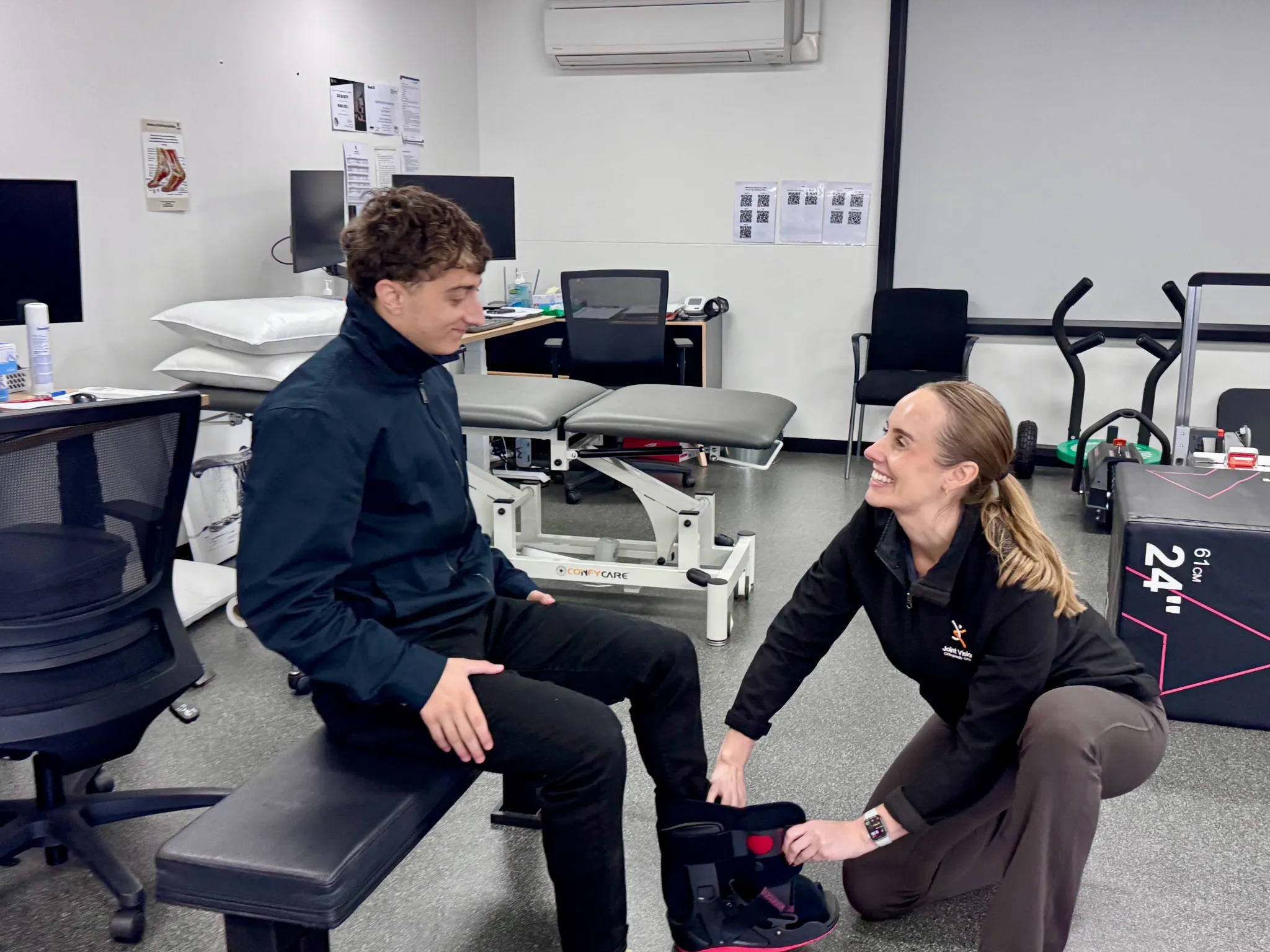
October 28, 2026
Written by
Dr Meghan Dares
After a broken ankle, patients often ask when they can walk again, return to work and regain their independence. Weeks on crutches can affect almost every part of life, from showering and shopping to caring for children.
For many years, six weeks without putting weight through the operated ankle was a common approach. Research now supports earlier weight-bearing for suitable patients after ankle fracture surgery, with potential benefits for early function and everyday mobility.
At Joint Vision Orthopaedic Group in Wollongong, I welcome patients from Nowra, the Shoalhaven and the wider South Coast for ankle fracture assessment and treatment. My focus is on protecting healing while helping patients return to the activities that matter to them.
Pictured: Alicia Frey, Joint Vision’s Allied Health Team Lead and Senior Physiotherapist, helps a patient with a walking boot.
What does early weight-bearing mean?
Weight-bearing means putting some or all of your body weight through the injured leg. After surgery, early weight-bearing commonly means beginning this process at around two weeks, rather than waiting six weeks. Some research has examined walking even earlier.
The amount of weight, walking aids and protection required vary. Permission to walk in a prescribed boot does not mean the fracture has fully healed or that running, twisting and heavy lifting are safe.
Support, loading and ankle movement are separate decisions. You may begin walking in a boot while still needing protection and a carefully supervised exercise programme.
What does the evidence show?
Evidence supporting earlier rehabilitation has developed over many years. A 2016 randomised trial by Dehghan and colleagues compared weight-bearing and ankle movement from two weeks with six weeks of non-weight-bearing and cast immobilisation. Patients starting earlier had better movement and function at six weeks, although there was no significant difference in return-to-work time.[1]
The WAX trial, published in The Lancet in 2024, involved 561 adults across 23 UK hospitals. It compared weight-bearing from two weeks with waiting six weeks after ankle fracture surgery. Earlier weight-bearing was at least as effective, with a modest average improvement in ankle function at four months. The trial found no statistically significant difference in complications.[2]
A smaller Dutch randomised trial involving 115 selected adults also reported earlier return to work and sport with unprotected early weight-bearing.[3] More recently, the 2025 INWN trial compared walking in a boot from the first postoperative day with six weeks without weight-bearing in a cast. It reported better early function and earlier return to work, with similar complication rates.[4]
These findings support considering earlier loading. They do not mean every ankle fracture should follow the same protocol, or that walking immediately without protection suits everyone.
Who may be suitable for earlier walking?
The decision depends on the fracture pattern, the stability achieved during surgery, bone quality, skin condition and wound healing. Associated ligament injuries and any additional procedures also influence rehabilitation.
Reduced protective sensation, including peripheral neuropathy, requires particular caution. Wound problems or concerns about fixation may mean weight-bearing needs to wait. Older age alone does not automatically rule out earlier rehabilitation, but balance, general health and the ability to use walking aids matter.
Your surgeon should explain why a particular plan suits your injury. Continue following that plan until your treating team changes it.
My approach to ankle fracture recovery
At Joint Vision, my usual approach for suitable patients is to protect the ankle during the first two weeks after surgery and review the wound as it heals. A boot or cast is selected according to the individual circumstances.
At approximately two weeks, if the wound is healing well and fixation is satisfactory, we can often begin a gradual increase in weight-bearing and ankle movement. Physiotherapy guides progress, with ongoing attention to swelling, comfort, walking technique and the wound.
Some patients need a slower pathway. Beginning rehabilitation earlier still requires follow-up and adjustment as recovery progresses.
Can this help you return to work sooner?
Earlier walking may make everyday tasks easier and support a gradual return to independence. Some trials have demonstrated earlier return to work, but this benefit has not been consistent across all studies.
A person working at a desk has different requirements from someone climbing ladders, carrying equipment or standing throughout a shift. Modified duties, shorter hours and opportunities to elevate the leg may help with a staged return.
Walking in a boot also does not automatically mean you can drive. Driving readiness requires separate assessment. Work and activity decisions should reflect healing, function and the demands of the task.
Ankle fracture care for Wollongong and the South Coast
My focus is on recovery that extends beyond an X-ray. We discuss the activities you want to regain and use those goals to guide rehabilitation alongside clinical assessment.
Patients travelling from Nowra, the Shoalhaven and other South Coast communities are welcome to seek care at my Wollongong practice. We can discuss follow-up requirements and coordination with local rehabilitation providers where appropriate.
Discuss your ankle fracture recovery
To arrange an appointment with Dr Meghan Dares at Joint Vision in Wollongong, request an appointment or call our Patient Services team on (02) 4250 4500. Speak with your GP or treating doctor about a referral, and include your imaging and any previous operation details.
You can also explore our foot and ankle care, Fracture and Injury Clinic and physiotherapy and rehabilitation services.
This article provides general information. Your individual weight-bearing instructions should come from your treating surgical team.
About the author
Dr Meghan Dares is an orthopaedic foot and ankle surgeon at Joint Vision Orthopaedic Group in Wollongong. Her practice includes ankle fracture assessment, surgical treatment and recovery planning for patients from the Illawarra, Shoalhaven and South Coast.
References
- Dehghan N et al. Early Weightbearing and Range of Motion Versus Non-Weightbearing and Immobilization After Open Reduction and Internal Fixation of Unstable Ankle Fractures. J Orthop Trauma. 2016;30:345–352.
- Bretherton CP et al. Early versus delayed weight-bearing following operatively treated ankle fracture (WAX). Lancet. 2024;403:2787–2797. Correction published 2025.
- Smeeing DPJ et al. Weight-bearing or non-weight-bearing after surgical treatment of ankle fractures. Eur J Trauma Emerg Surg. 2020;46:121–130.
- Khojaly R et al. Immediate Weight-Bearing Compared with Non-Weight-Bearing After Operative Ankle Fracture Fixation: Results of the INWN Trial. J Bone Joint Surg Am. 2025;107:1423–1438.
Information on this website is general and may not apply to your circumstances. It does not replace individual clinical advice. If you have a health concern, use the relevant care pathway or speak with a qualified health professional. Seek urgent help for severe or rapidly worsening symptoms or a possible emergency.
What to do next