
Joint Vision news
Wollongong's Joint Vision recognised alongside global medical giants in national innovation awards
Wollongong's Joint Vision earned national recognition as a 2026 AFR BOSS Most Innovative Companies Medical finalist alongside Medtronic and Nanosonics.
Back to Insights
October 21, 2026
Written by
Joint Vision
A Wollongong-based orthopaedic group has earned national recognition alongside some of the biggest names in healthcare and medical technology at the 2026 Australian Financial Review BOSS Most Innovative Companies Awards.
Joint Vision Orthopaedic Group was named among just 10 finalists in the Medical category, sharing the national stage with organisations including global healthcare technology company Medtronic and Australian medical technology company Nanosonics.
The recognition was celebrated at the Four Seasons Hotel in Sydney on Wednesday 21 October 2026. It acknowledged a model of care developed in the Illawarra that connects specialist orthopaedic assessment, imaging, treatment and rehabilitation around the patient.
The awards attracted more than 500 entries nationally, with 80 finalists selected across the program.
An Illawarra healthcare model on the national stage
For an independent healthcare organisation established in Wollongong, a place in that finalist field is a significant achievement. Joint Vision's entry centred on rethinking how orthopaedic healthcare is delivered and making the patient journey easier to navigate.
The innovation is in how the care comes together: the services patients can access, the way clinicians communicate and the connections between assessment, treatment and recovery.
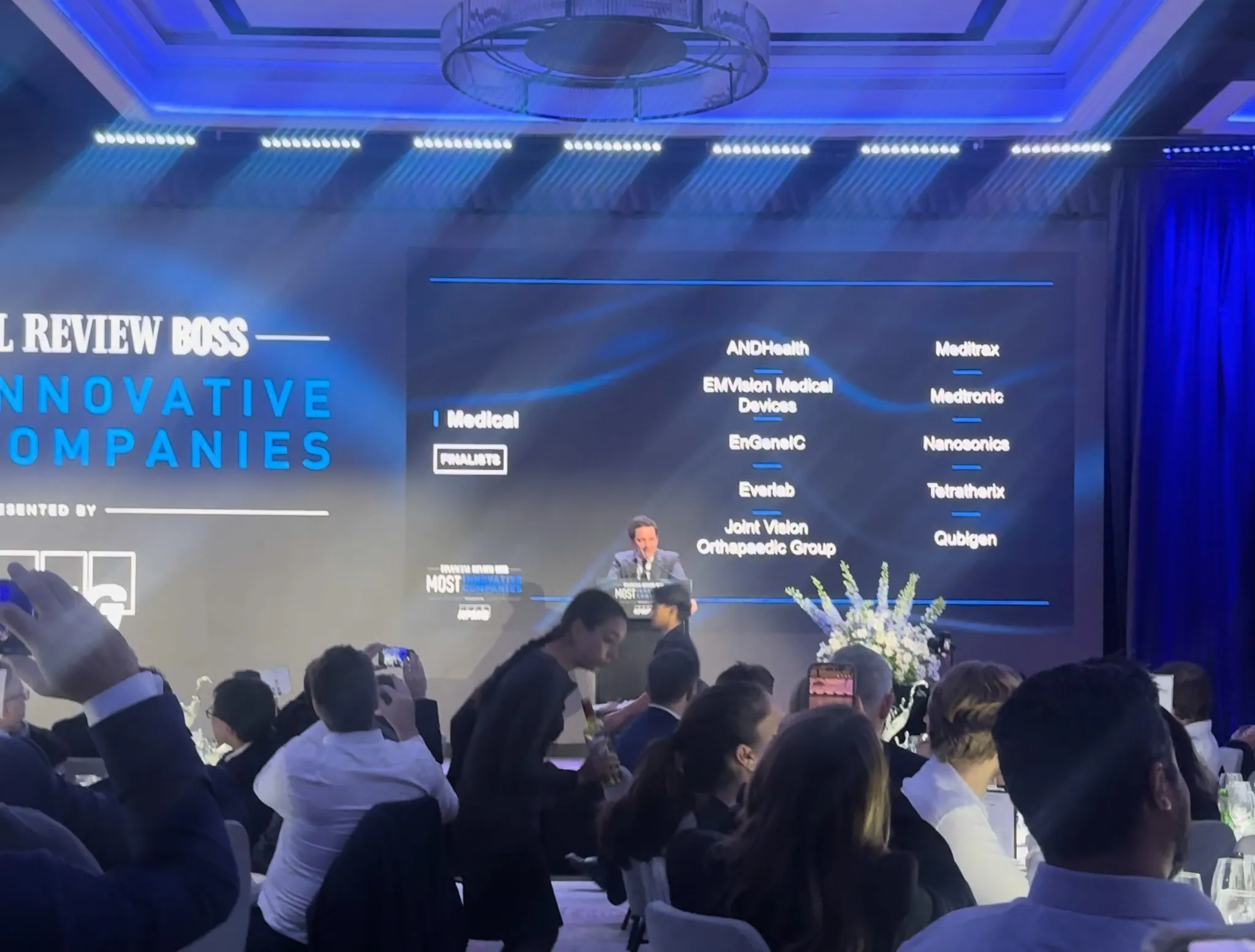
Chief executive Wynter Dares attended the ceremony and accepted Joint Vision's Medical finalist certificate on behalf of the organisation. The recognition placed the work of a local team alongside major national and international companies.
Care built around the person
For someone living with pain or recovering from an injury, finding the right care can involve several appointments, separate providers and uncertainty about what happens next.
Joint Vision developed its coordinated model to make that journey clearer, bringing orthopaedic specialists, allied health, onsite X-ray and musculoskeletal ultrasound, nursing and rehabilitation together around the patient.
Our team supports people with conditions affecting the shoulder, elbow, wrist and hand, hip and knee, foot and ankle, along with fractures, injuries and other musculoskeletal concerns.
Depending on their needs, patients can begin with a specialist, an allied health clinician or our injury and fracture service. Assessment and investigations inform a plan that can connect surgical or non-surgical treatment with rehabilitation.
Co-founder and orthopaedic surgeon Dr Meghan Dares said the model grew from seeing the difficulties people faced when care was fragmented.
“When you’re dealing with pain or an injury, organising appointments and working out who to see can become another burden,” Dr Dares said.
“We wanted to make that journey easier to understand, with the right expertise around the patient and a team that communicates.
“An appointment with an orthopaedic surgeon doesn’t automatically mean surgery. The aim is to understand the problem, consider the options and help the person take the right next step.”
That approach puts innovation into everyday practice: questioning established systems and finding better, more connected ways to care for patients.
Recognition for the people who built the model
Making coordinated care work requires attention to the details, from scheduling and clinical handovers to sharing imaging, communicating with referrers and supporting recovery.
Surgeons, nurses, physiotherapists, other allied health professionals, imaging staff and the Patient Services and administrative teams all help make those connections work.
“Our clinicians, imaging professionals, nurses and patient services staff all contribute to how the care comes together,” Mr Dares said.
“The recognition acknowledged that collective effort. People across the organisation have helped identify gaps, develop services and improve the way we work.”
One example is Joint Vision's rapid-access Injury and Fracture Clinic, which originated within the physiotherapy team and connects assessment and injury management with specialist follow-up where required.
The model is supported by an established clinical service. Joint Vision delivered more than 21,000 appointments and welcomed 3,654 new patients in FY2026.
Research and education connected to care
Through the Joint Vision Orthopaedic Research Institute (JVORI), the team has collected more than 10,000 patient-reported outcome measures to help evaluate care pathways and inform research.
JVORI collaborates with the University of Wollongong on ethics-approved research projects. Joint Vision also supports four accredited orthopaedic fellows annually and provides continuing medical education for GPs and other health professionals.

For Meghan, Wynter and the wider organisation, the finalist recognition is an opportunity to share what the team has developed in the Illawarra and continue improving it.
“We’re proud of what our team has built, and we want to keep asking where we can improve,” Dr Dares said.
“The focus remains on helping people understand their options and keeping their care connected through treatment and recovery.”
Thank you to our team, patients, referrers and research and community partners who have contributed to Joint Vision's development and this national recognition.
Find the right care
Whether you need help with an injury, ongoing pain or rehabilitation, our Patient Services team can help you find the appropriate starting point.
Explore our care pathways, learn more about Joint Vision's services or call (02) 4250 4500.
Information on this website is general and may not apply to your circumstances. It does not replace individual clinical advice. If you have a health concern, use the relevant care pathway or speak with a qualified health professional. Seek urgent help for severe or rapidly worsening symptoms or a possible emergency.
What to do next